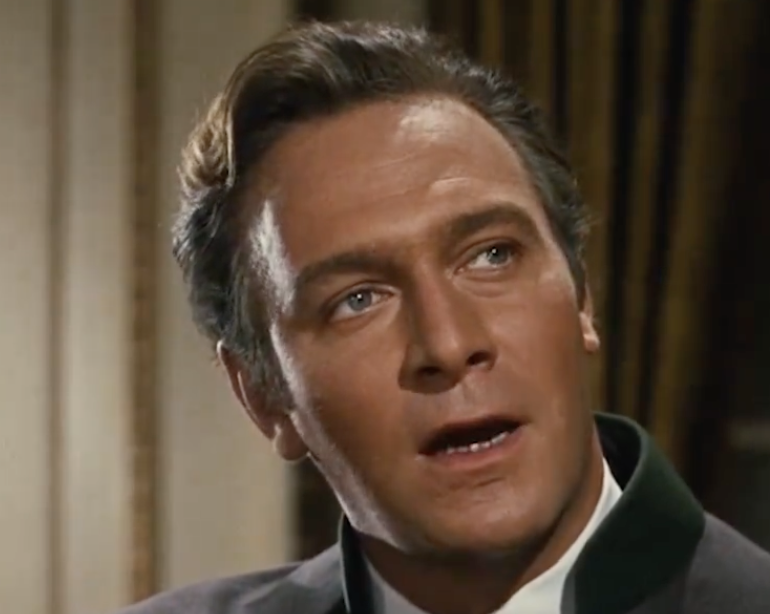
Imagine the festival scene in Salzburg, 1965. The lights dim, the audience hushed. Captain von Trapp steps forward, guitar in hand, and begins “Edelweiss” in his own voice—no studio sheen, no borrowed baritone, just Christopher Plummer, raw and trembling.
You’d hear the tiny catch in his throat when the lyrics turn to “forever,” the way his voice almost breaks on “blossom of snow, may you bloom and grow,” because the song has just become goodbye to his country, his children, everything he loves. That little fracture would have traveled through the theater like a shiver. The camera would linger on his eyes filling, on Maria’s hand finding his, on the children realizing their father is singing through tears he refuses to let fall.
There would be no perfect sustained notes, no polished vibrato; just a man who has never sung in public in his life, singing now because the moment demands it. The imperfection would have made the moment unbearable and perfect at once.
This is the version Christopher Plummer actually recorded—his own voice, voice-cracks and all—before the studio stepped in.
IT’S FINALLY HERE! 🥹 For the first time ever, nearly 60 years after the film’s release, listen to Christopher Plummer’s ✨ORIGINAL✨ vocals for “Edelweiss” in The Sound of Music. (ICYMI: he was dubbed by Bill Lee in the 1965 film.)
— The Sound of Music (@SoundofMusic) December 1, 2023
Watch the full clip: https://t.co/CJctXIDox7 pic.twitter.com/DP23VHgrJg
Director Robert Wise and the producers ultimately chose to replace it with the smoother, more operatic baritone of Bill Lee, the legendary Hollywood playback singer (the same voice you hear as Prince Charming in Disney’s Cinderella and Lieutenant Cable in South Pacific). They wanted the crystalline perfection that 1960s movie-musical audiences expected, especially beside Julie Andrews’s flawless soprano.
So Bill Lee’s pristine take became the one the world fell in love with, the one that played in theaters and living rooms for six decades. Plummer’s original, more fragile rendition was shelved—until 2023, when the Super Deluxe Edition of the soundtrack finally let it see daylight, like a letter found in an attic, still warm with what might have been.
That is the “Edelweiss” that almost was.
And now, at last, it is.